 Essen, horizontal view
Internet Project
Observing, Photographing and Evaluating the
Transit of Venus, June 8th, 2004
 Essen, equatorial view
|
Essen, horizontal view
|
Internet ProjectObserving, Photographing and Evaluating theTransit of Venus, June 8th, 2004 |
Essen, equatorial view
|
The distance to the Sun has been determined!
The procedure was:

A detailed evaluation and exercises in position measurements and deriving the solar parallax can be found in our forum.
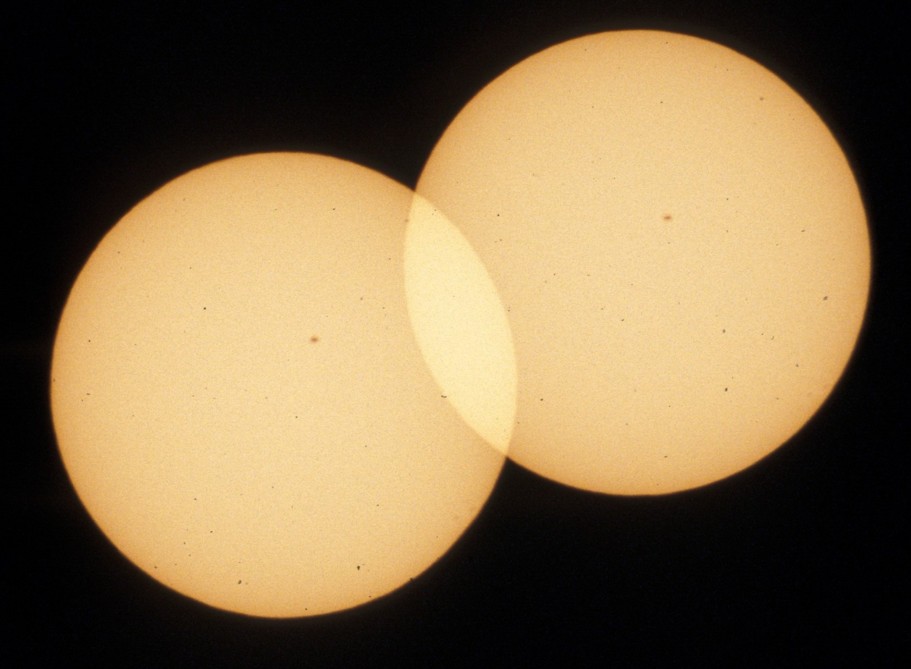
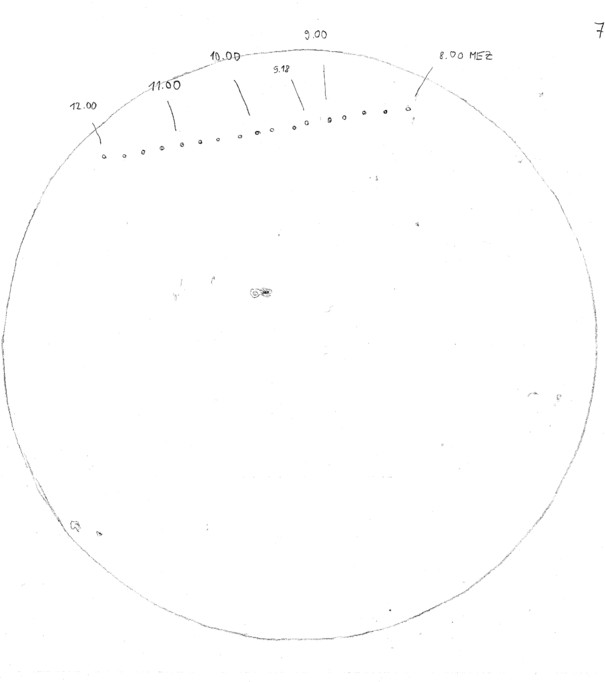
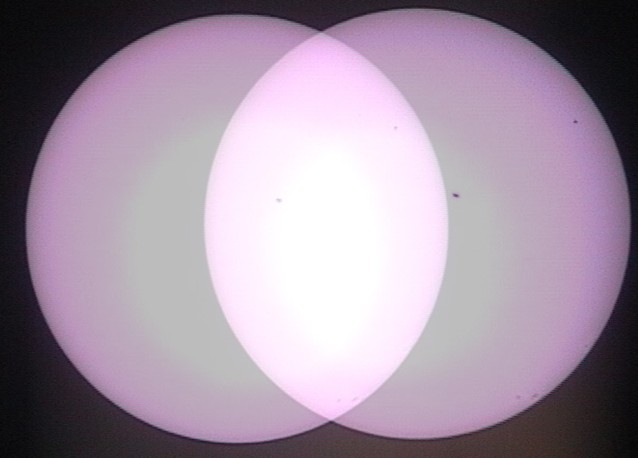
We've got very few pictures of the transit of Mercury. Most of them are not focussed well enough, deformed either by photographing the projection at an angle or during the transformation from slides to digitized pictures, have no unambiguous orientation or are unevaluable for other reasons. This fact shows us how important it is to get experience in photographing the Sun (see our related project)! Therefore, we are happy that we have been able to derive at least a rough measure for the solar parallax.
| 
| 
|
|---|---|---|
| Essen, Germany, 9.45 UT
(double exposured slide, f=800mm, Δt=90s) | Keplergymnasium Pforzheim, Germany
(projection with marked positions of Mercury, Δt=15min) | International Amateur Observatory, Namibia, 9.45 UT (two video pictures, afterwards added and stretched to circular pictures of the Sun) |
With the following data
With the following data
By putting the positions into Excel worksheets we got the following line fits:
| x | = | 0.33975 | + | 0.00383068 | *t |
| y | = | 0.6474 | - | 0.001816715 | *t |
| x | = | 0.36015 | + | 0.003705 | *t | |
| y | = | 0.6563 | - | 0,001922 | *t |
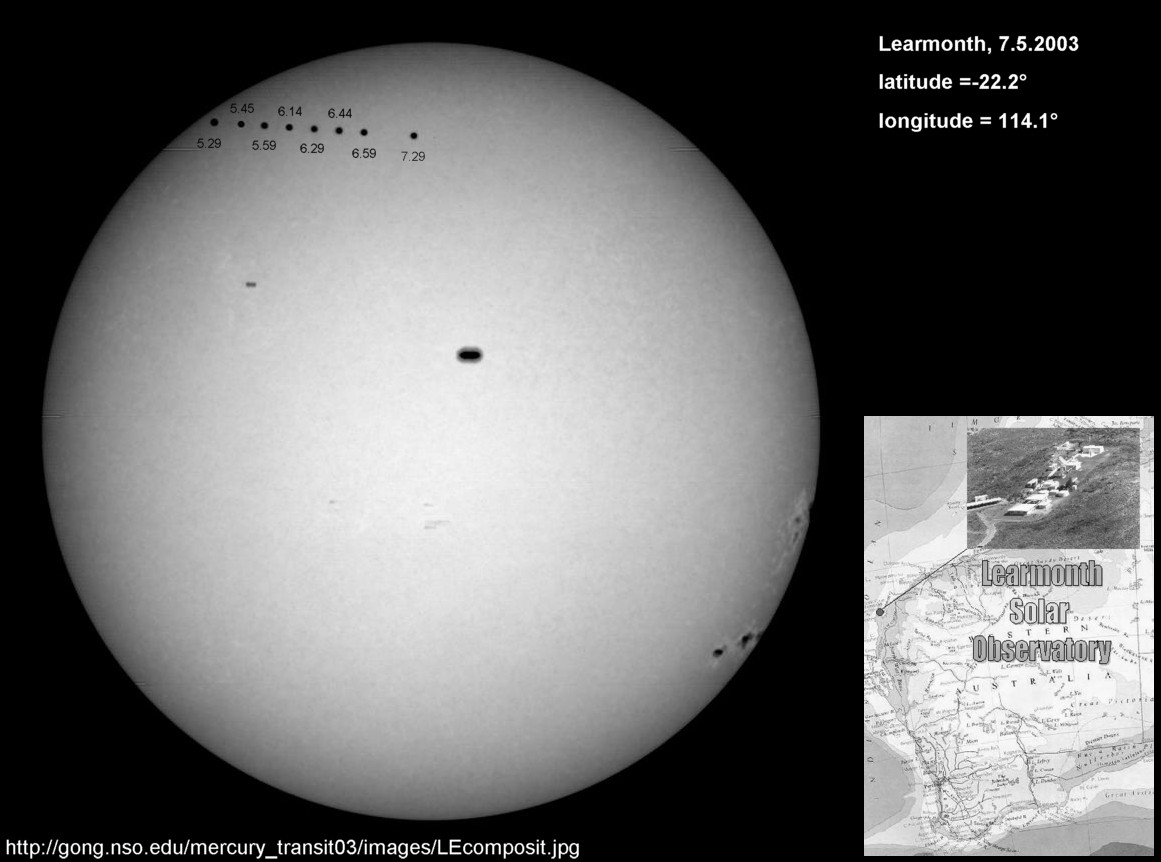
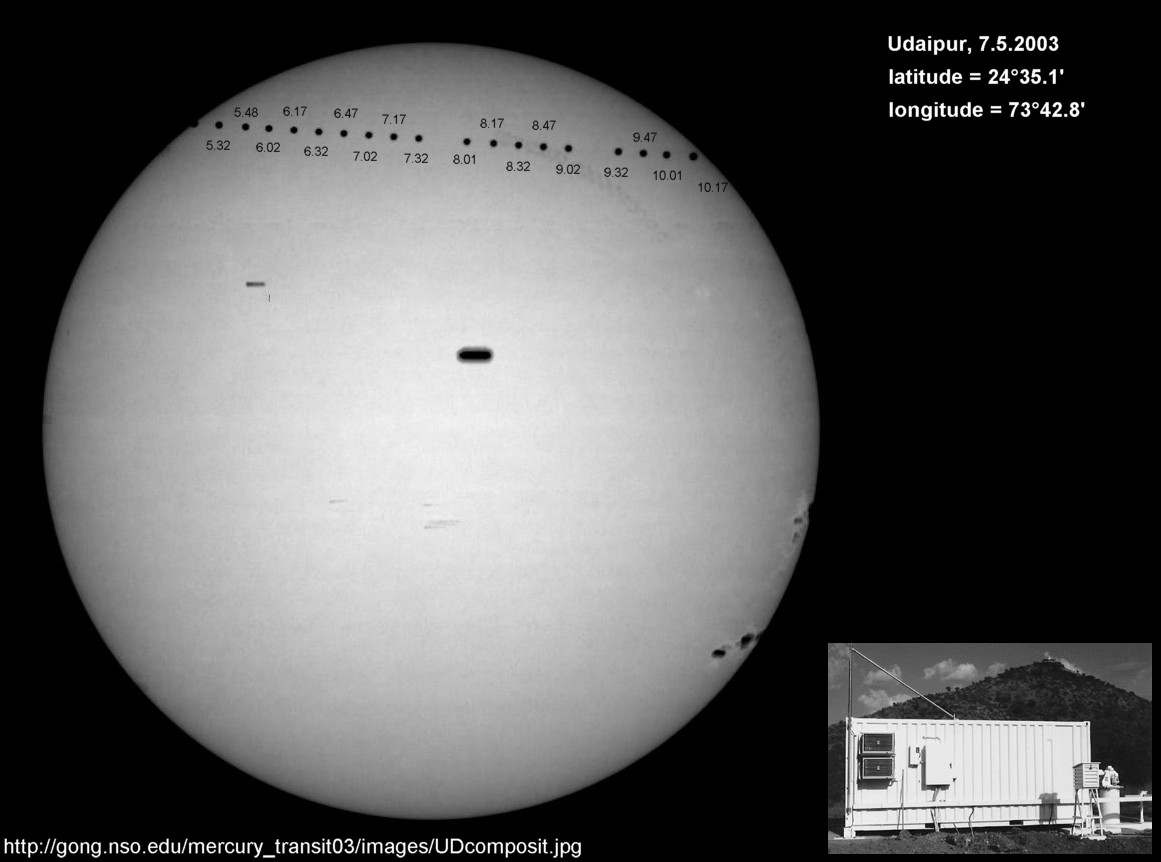
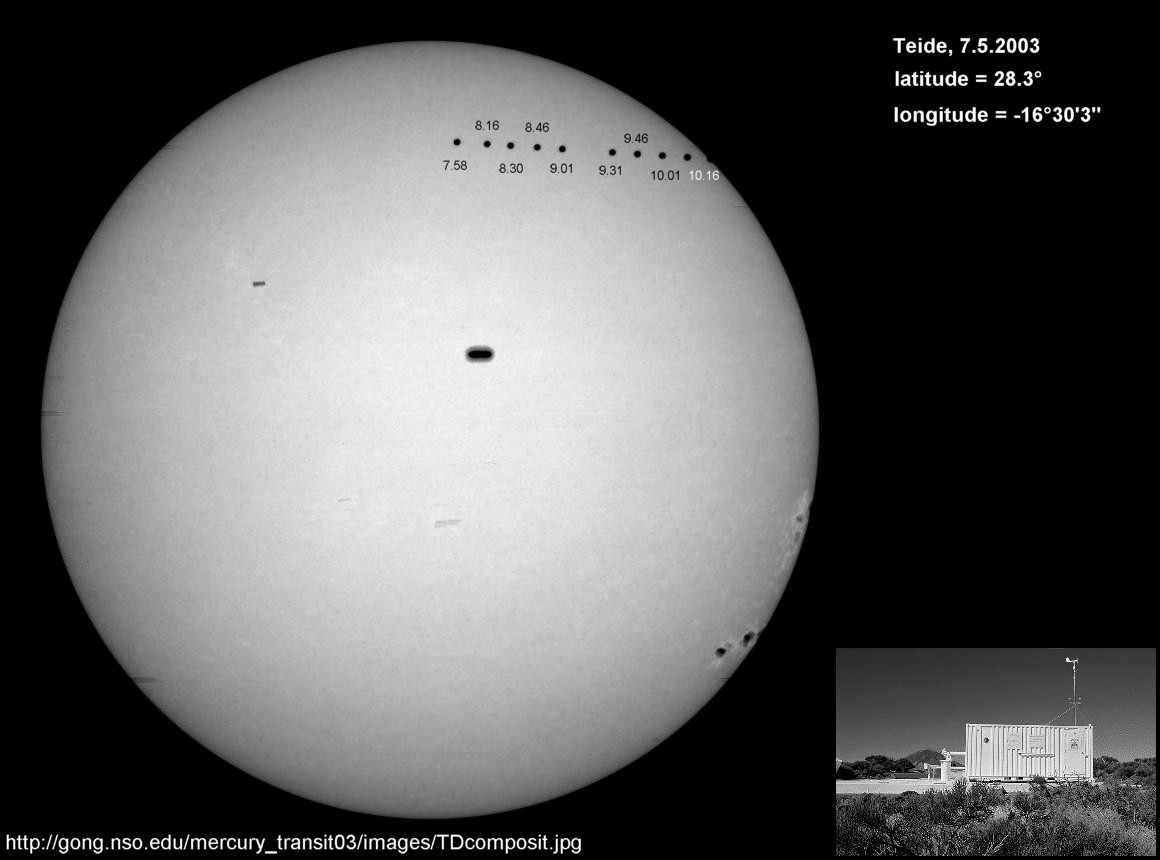
Some weeks ago, we were happy to get informed about the GONG network and the transit pictures taken by its solar observatories. They offer a very good opportunity to test our evaluation procedure. (Again, you can find the complete evaluation in the evaluation paper which can be downloaded from our forum.
|
|
|
| Learmonth, Australia | Udaipur, India | Teide, Canary Islands, Spain |
|---|
The only directly comparable pictures are taken by the observatories of Udaipur (φ = 24.6°, λ = 73.7°) and Teide (φ =28.3°, λ = -16.5°) at 10.01 UT.
For these pictures we found the following positions of Mercury:
Because of the large distance between Teide und Learmonth (φ = -22.2°, λ = 114.1°) we can expect the best measure of the solar parallax from the line fits of these observatories.
| x | = | 0.07778 | + | 0.004262 | *t |
| y | = | 0.7376 | - | 0.0002689 | *t |
| x | = | 0.08539303 | + | 0.004226435 | *t |
| y | = | 0.7478 | - | 0.000292166 | *t |
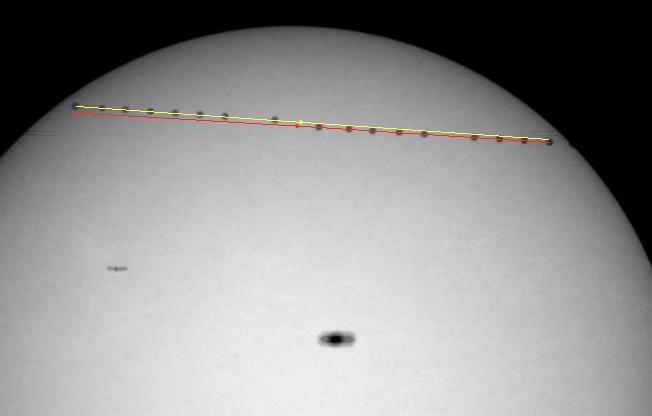
The combined Learmonth and Teide picture below visualizes the parallax of Mercury: It shows that Mercury, observed from Teide and Learmonth, run different paths over the Sun's face. Additionally, the extrapolated positions demonstrate the parallactic shift. Because their connection line is not perpendicular to the both paths the parallactic shift is larger than the distance between the paths.
Perhaps, a little Powerpoint presentation (1.22 MB) may visualize the parallax
of Mercury even more clearly:


 Prof. Dr. Udo Backhaus